

Costa Rica: From Cloud Forests to Crocodile Rivers
Costa Rica was on my bucket list for nearly a decade. I had sketched itineraries during lunch breaks, built spreadsheets of routes and driving times, and bookmarked must-see-attractions and must-eat-foods with almost academic precision. So when we decided to make a trip in early December, I was ready with my excel spreadsheet, list of activities I wanted to do and places I wanted to see. The start was rocky. Our son had been battling a cough that turned into pneumonia days before departure. On the morning we were supposed to leave for the airport, we got up early in the morning, checked up on him and decided we cannot go and just turned back and went to sleep. A trip to the doctor later in the day, confirmed that he was on the mend, so we rearranged our itinerary, got a new flight for the next day and managed to salvage the rest of the trip.
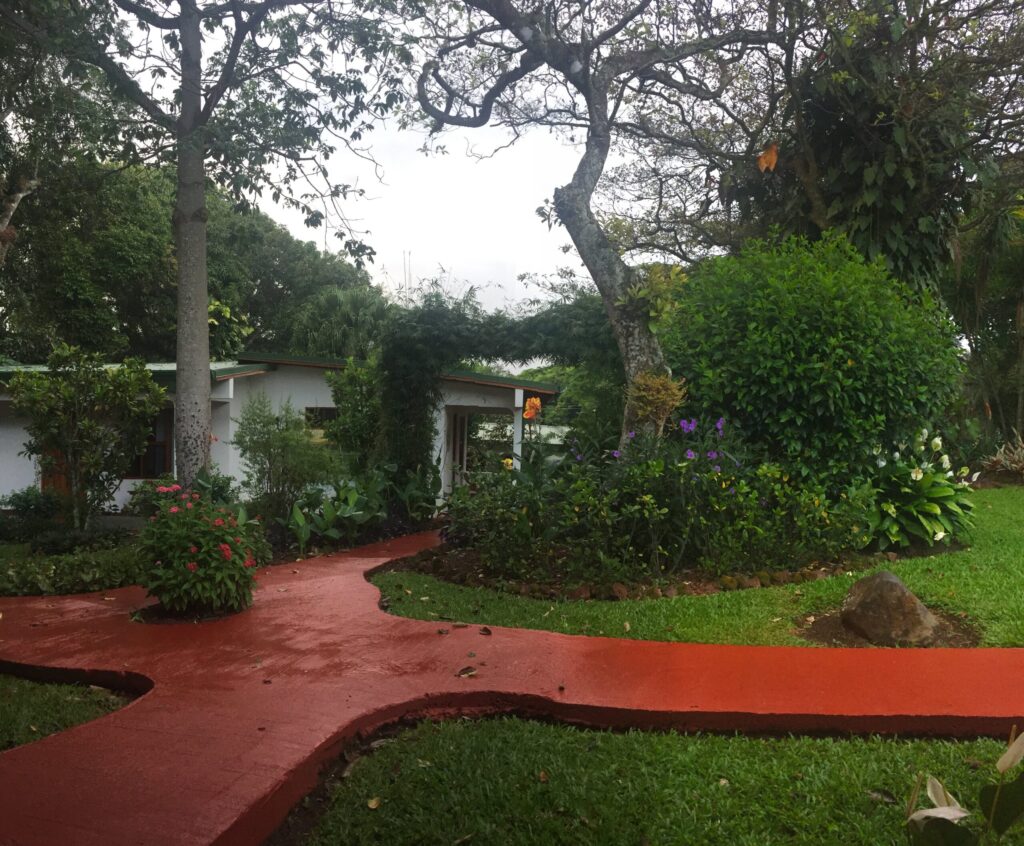
We landed in San José, Costa Rica’s capital and largest city, located in the Central Valley at about 1,100 meters above sea level. This metro area holds nearly one-third of the country’s population. We hired our rental car through Adobe Rent A Car and they were most accommodating when we had to push our car rental by a day and were prompt in picking us up and transporting us and our baggage to the car rental place. Though the formalities took some time (they seem to have adopted the Southern African motto of “Hurry Up Slowly”), they were done with a smile and before we knew it, we were sent off with a recommendation to stop at Denny’s for dinner. The airport area was crowded with flashy restaurants but many of them had a huge wait time, so we decided to grab something by our hotel. Unfortunately, by the time we reached the hotel, it was late night and there was no one that spoke or understood our English to help us. By this time, it was past 10pm and we were tired and decided to make do with the snacks that we had in our bags and pretty much crashed. We woke up to appreciate the beauty of Hotel La Rosa De America. Beautiful cottages, all decorated with flower motif, the sound of birds in the air and the promise of a hot Costa Rican breakfast. Breakfast introduced us to staples we would see throughout the trip: gallo pinto (rice and beans), fresh tropical fruit such as pineapple and papaya, eggs, fried plantains, and fresh juices.
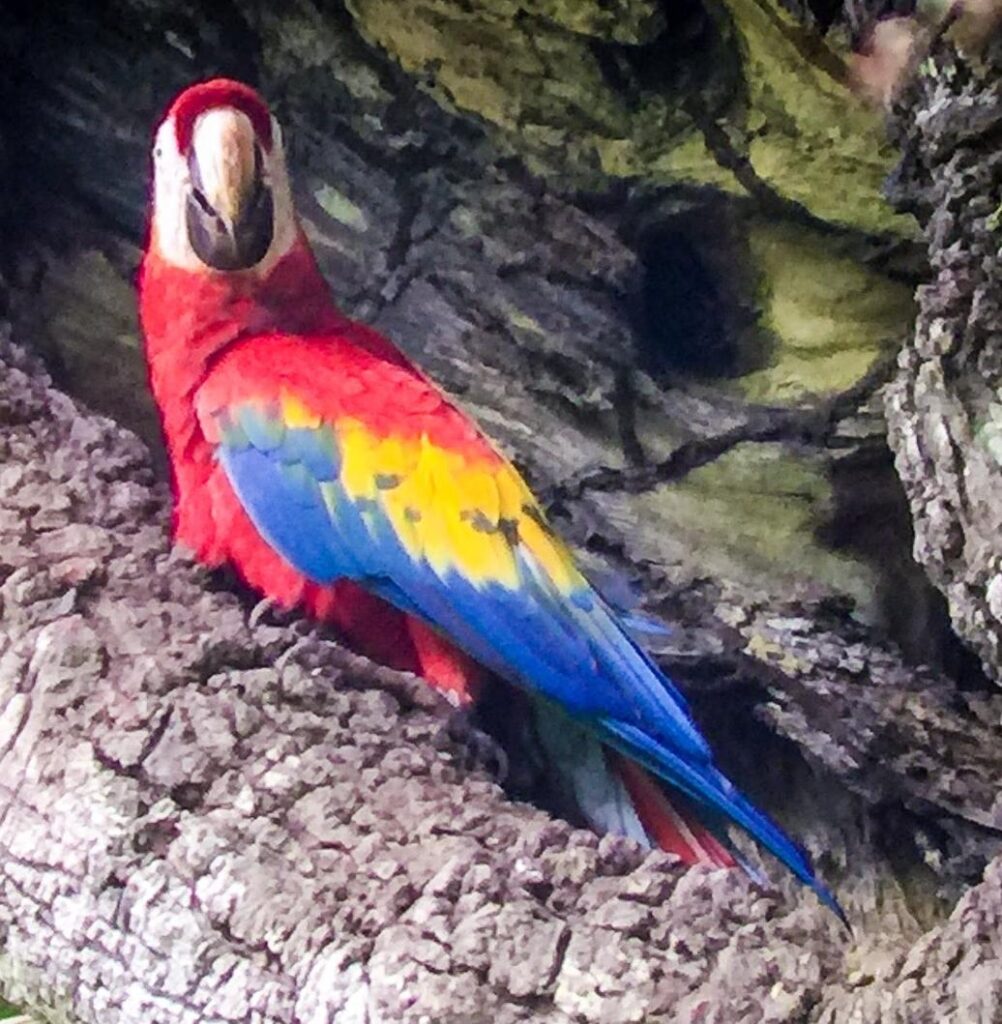
Carara National Park Our first major stop was Carara National Park, located along the Pacific transition zone – not really the rain forest but not the dry northern forests either. Carara is known for its birds, specifically the scarlet macaws. Carara’s well-maintained trails make it fairly accessible, but wildlife spotting without a trained guide can be challenging. The forest canopy is dense, and many species are masters of camouflage. We had hired Mauricio earlier via the net, who met us at the gate and immediately, even before we said hi, pointed out a hawk high up in the treetop. Armed with a spotting scope, he led us down an uneven 90 minute trail and showed us several different species of birds and animals.
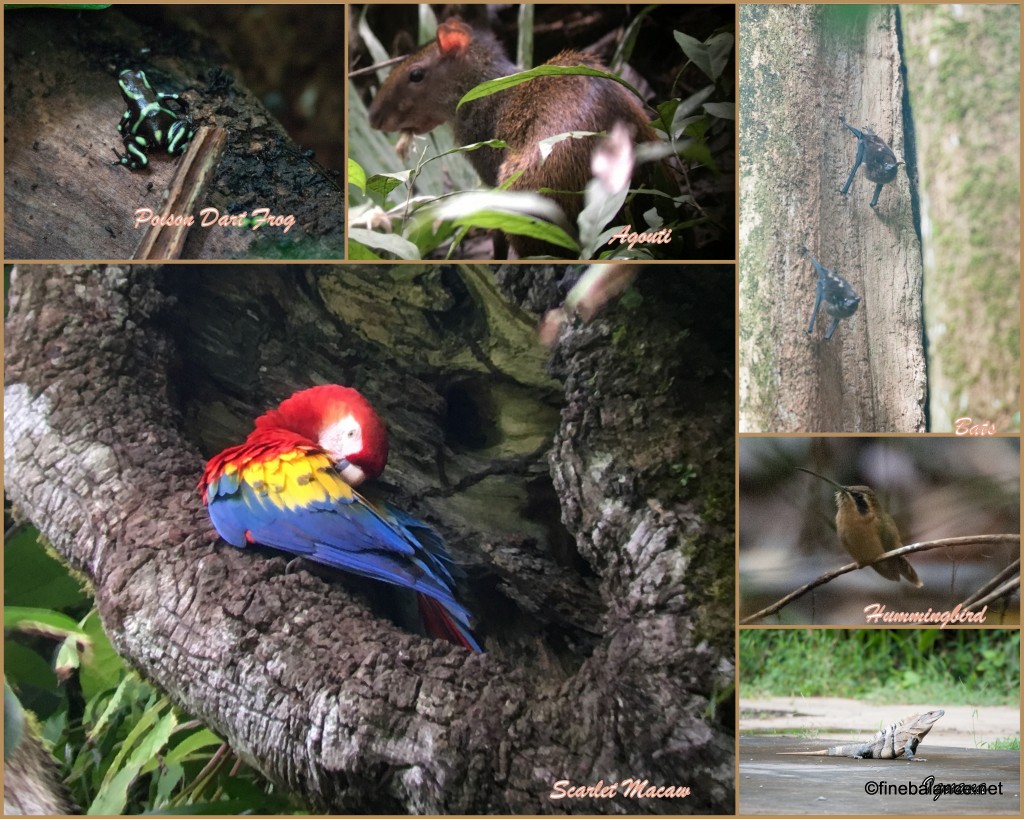
We learnt quickly that Costa Rican plants could prove to be deadly as well. There were some deadly mushrooms and toadstools lining our path. We saw the tiny but deadly green and black poison arrow frog, which apparently has enough toxins to make a human heart stop beating. We managed to see the Agouti, a large squirrel like rodent that’s about the size of a big cat. We saw some Capuchin monkeys, bats and iguanas too. There were plenty of hummingbirds but trying to photograph these extremely swift and tiny birds was a challenge. We managed to get some pictures of a Long-billed Hermit bird. Mauricio managed to show us the most defining bird of Carara, or indeed most of Costa Rica, the brightly colored scarlet macaws.
The Tárcoles Crocodile Bridge
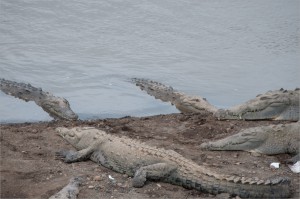
By now it was lunch time and we were pretty famished. But we had one more stop-over before lunch. Just outside Carara, the bridge over the Tárcoles River is famous for its large population of American crocodiles. These reptiles can grow over 15 feet long and are among the largest in the Americas.
I was a bit skeptical but the Crocodile Bridge as it is otherwise called ,definitely lived up to its name. We had to park at the side and then walk on the narrow pavement at the edge of the bridge to come up to a good viewing point. At a quick count there were more than 40 of these crocodiles lazing on the banks or floating idly in the river. The Tárcoles River basin supports one of the densest crocodile populations in the region. It was sort of thrilling and grotesque at the same time – I admit I was clutching the kids a little strongly when we were on the bridge.
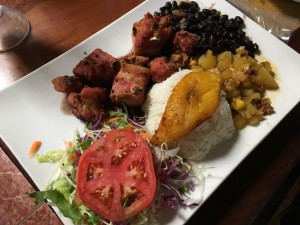
Just on the other side of the bridge was Restaurante Los Cocodrilos, an almost street-food style restaurant that had food, a snack shop and a souvenir shop all mixed into one. As in most places in Costa Rica, the fresh fruit juice didn’t disappoint. We also ordered fish and the casado platter: the national food of Costa Rica. It was, in my opinion, the Costa Rican version of the Indian thali.
The name means “married,” symbolizing the union of ingredients on one plate. It had rice and beans and vegetables, one cooked and one salad, some fried meat that you can choose and a piece of cheese and it is all topped with a delicious fried ripe plantain. It is essentially a working man’s lunch so the portion sizes are hearty and the food was certainly delicious.
Monteverde: The Cloud Forest
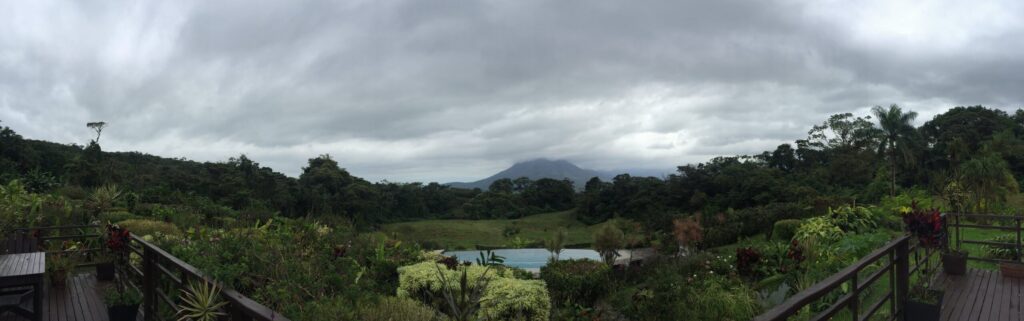
We had a long drive after this to Monteverde, the Costa Rican cloud forest region. The cloud forest is a unique ecosystem that is at a higher elevation and served by the low hanging cloud cover that is present at the level of the tree canopy. This often means that there is more life and growth at the canopy level than at the bottom where often the sunlight fails to penetrate. Monteverde is a small town about 1000 people who reside full-time but getting there was an adventure. There is only a dirt road that goes uphill with some sheer drops on either side, and we went bouncing away for the better part of an hour.
We had hired Marco from Pasion Costa Rica, a friendly guide who told us a lot about Costa Rica’s history. He and his family were local and lived there for a couple of generations. One of the fascinating things that I learnt from him was that in 1948, just after World War II, the President of Costa Rica abolished the military. This leaves the country a lot more money for development and a lot of it was poured into schools. School teachers receive an above average pay and there are schools everywhere. Poverty didn’t seem as apparent in Costa Rica and in general the Ticos were happy and the country seemed to be developing, especially compared to their other Central American neighbors.
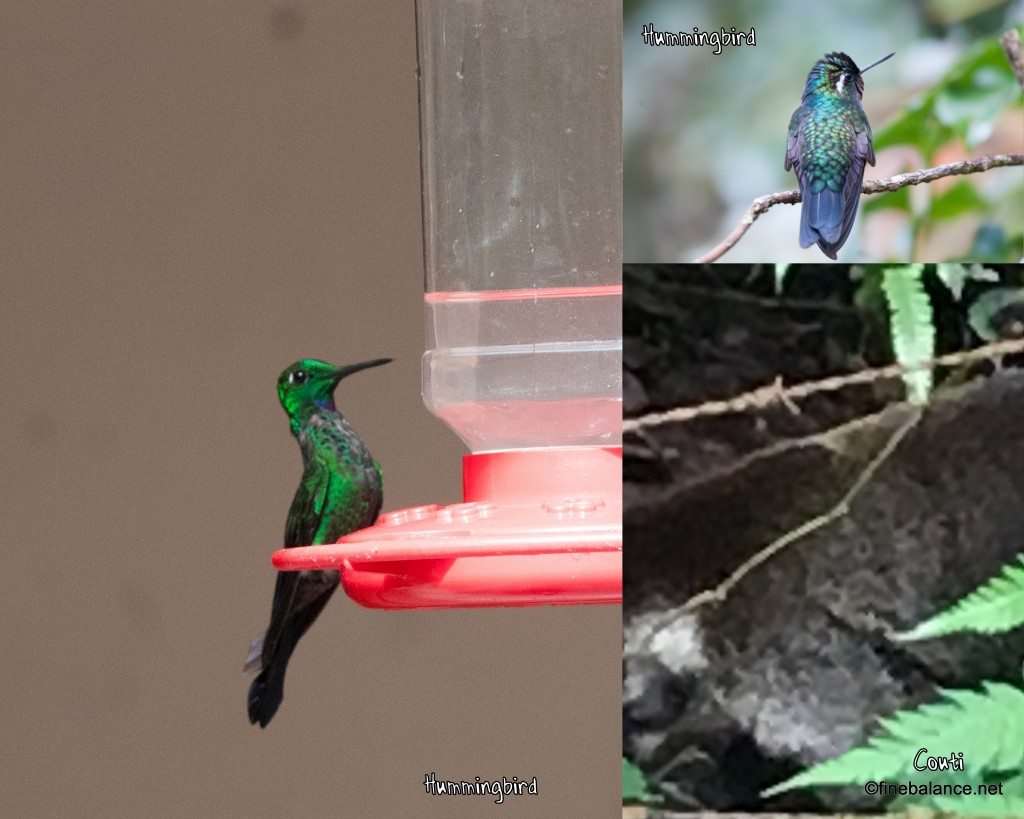
It was a terrible day for animal sightings though at the Monteverde Cloud Forest Biological Reserve. Marco tried a lot, but it just wasn’t his day or ours. The start was good. We stopped at a hummingbird feeding center and we saw more hummingbirds than we have ever seen before. It was a good place to appreciate the differences in types of hummingbird, both color, size and features. We also managed to see a mammal called couti with a long curved tail belonging to the raccoon family. Other than that and a few birds, we pretty much didn’t see anything of interest. The cloud forest itself was beautiful, lush and green like a rainforest but much cooler due to the high altitude. Monteverde is also known for the resplendent quetzal, a brilliantly colored bird revered in Mesoamerican cultures. Though we did not see one, the reserve is one of the best places in the world for quetzal sightings during nesting season.
However what I am truly grateful to Marco for was the recommendation to eat at Restaurante Sabor Tico. One of the best things we ate was chorreadas, corn pancakes made by squeezing out the juice from young corn. The chorreada was a revelation on how corn cakes could really be. This also seemed to be a rare thing because I searched for chorreadas in all other restaurants that I went to in Costa Rica and couldn’t find it. The other revelation was the horchata. I have had horchata in US before but I never really understood what the fascination was with this till we had it here. Horchata is rice milk with cinnamon and vanilla. Unlike the watery sugary drink that I was used to, this version was creamier with just a hint of cinnamon and sweet without being cloying. I think we each had a couple of glasses.
Arenal and Lake Arenal
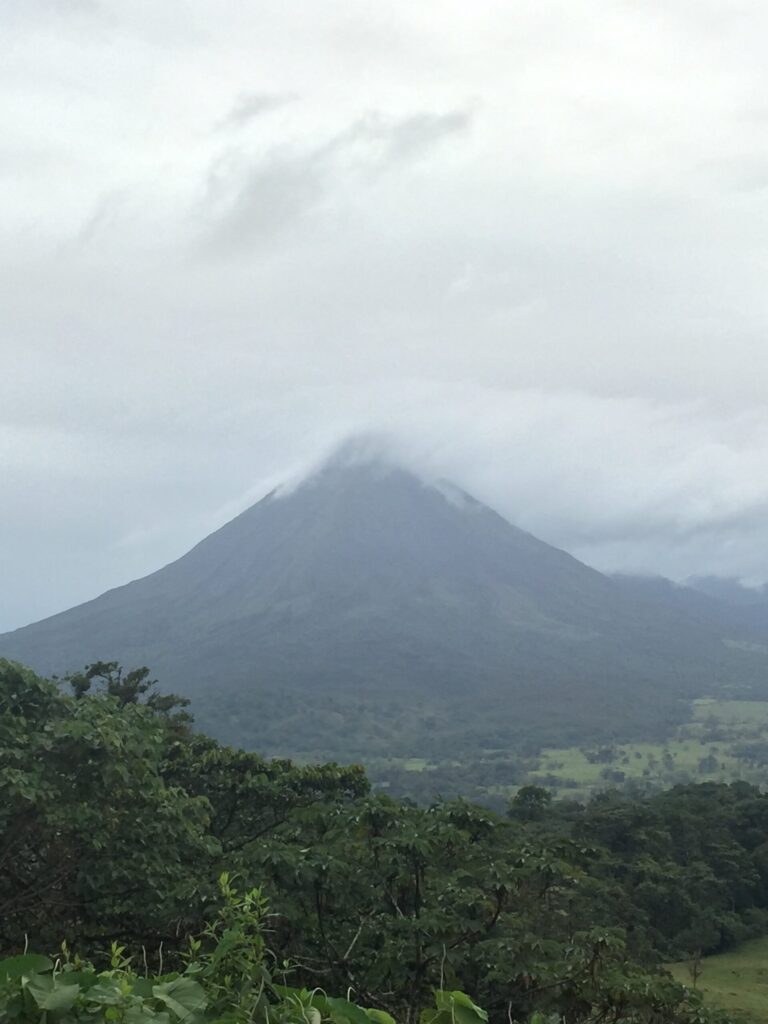
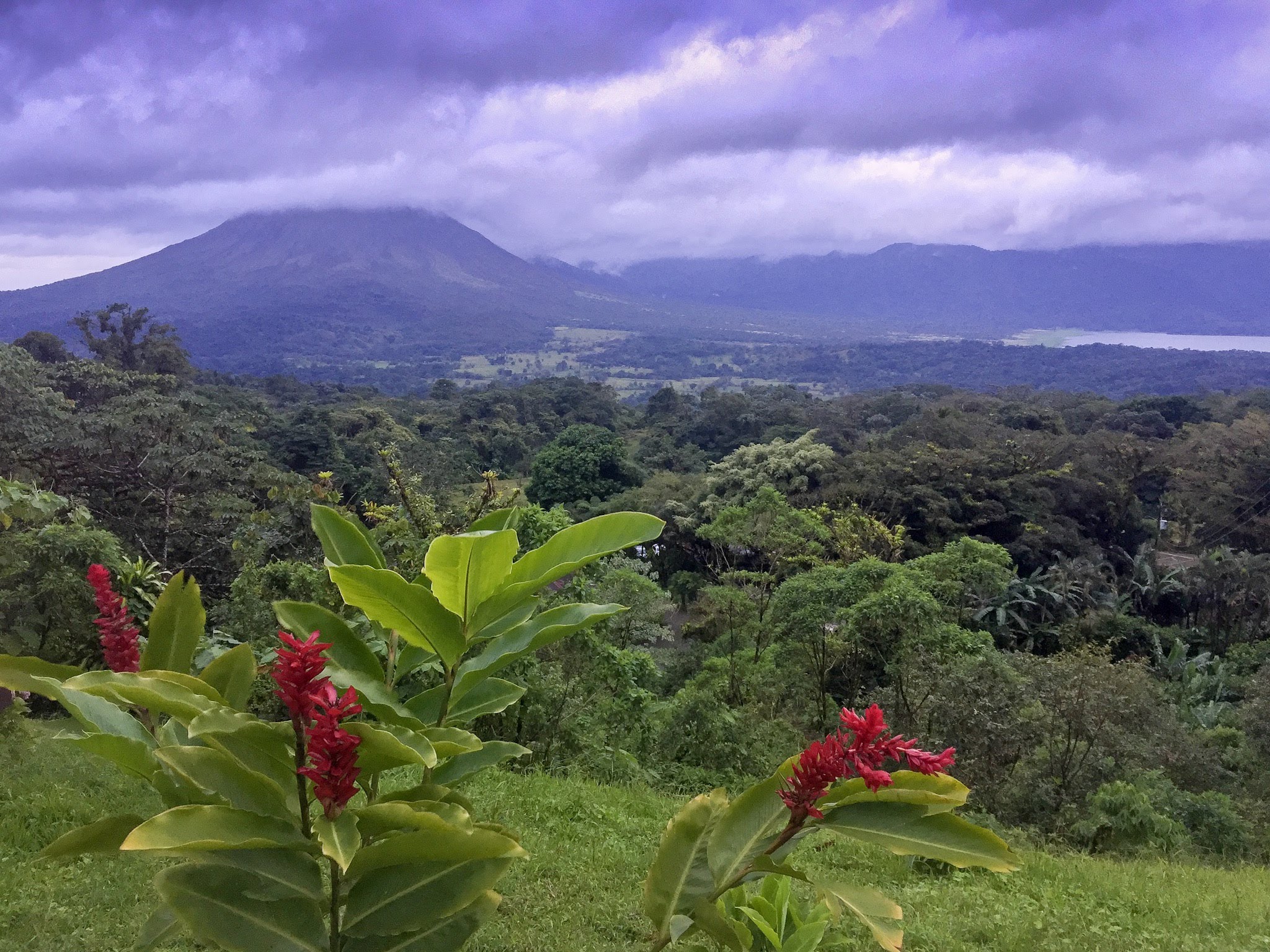
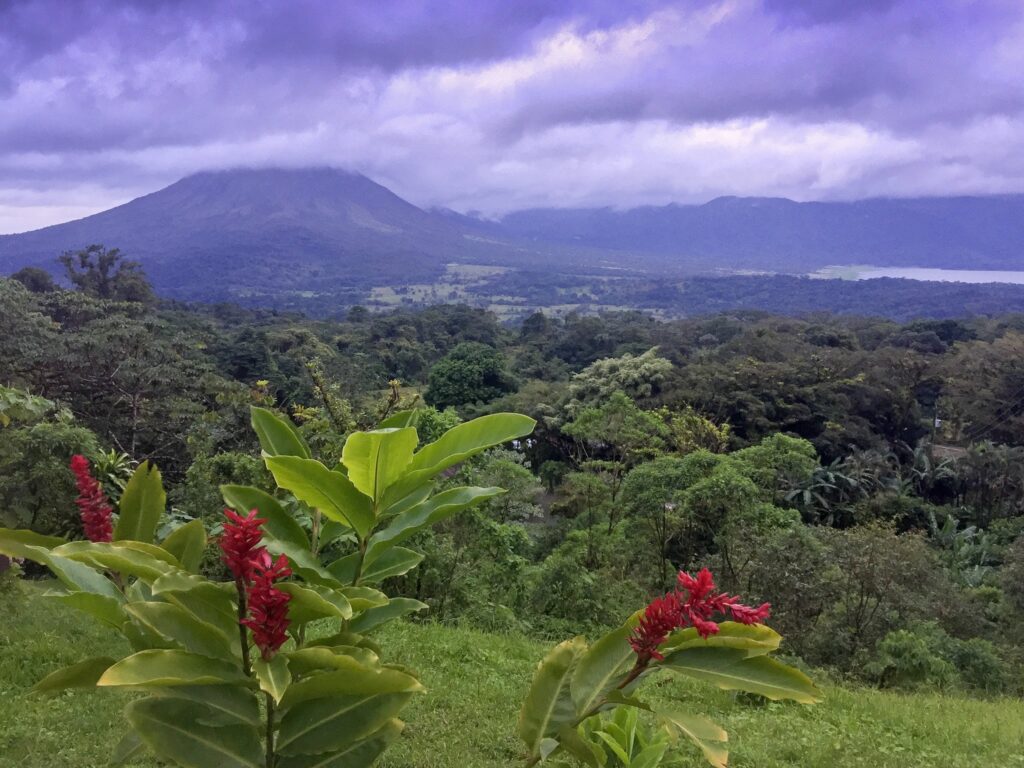
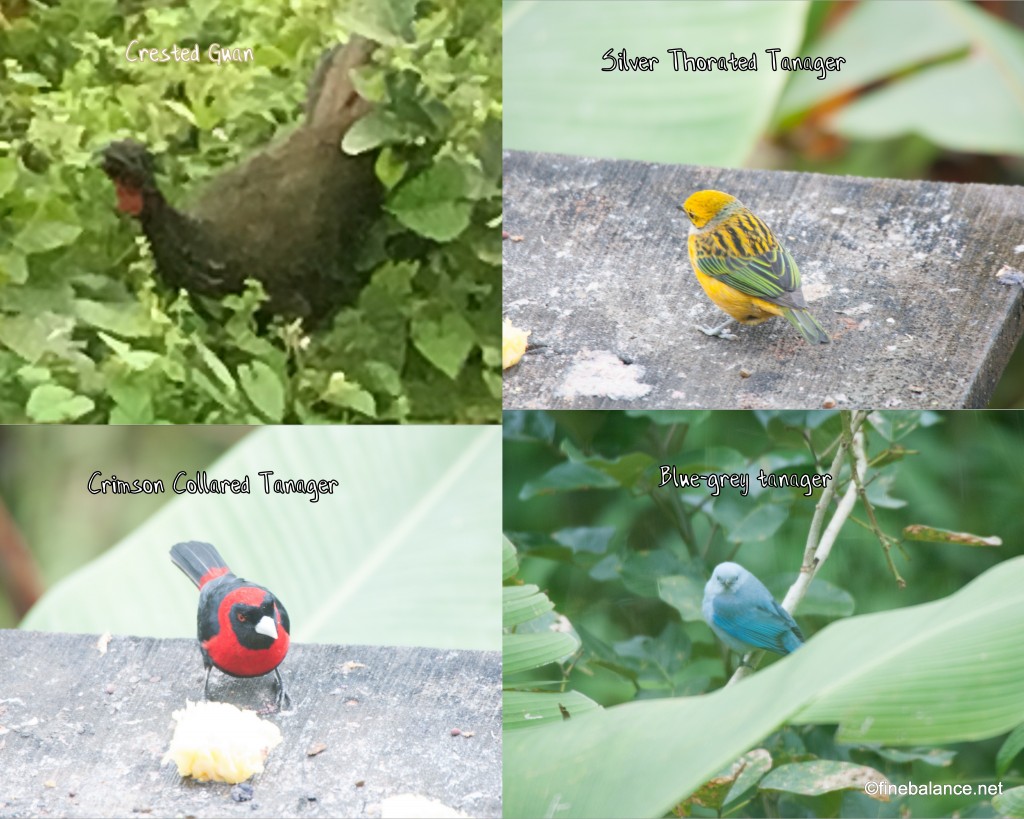
We continued to the Arenal region, dominated by Arenal Volcano, one of Costa Rica’s most iconic landmarks. Though considered dormant since 2010, Arenal was highly active for decades, with regular lava flows visible until the early 2000s. We had booked one of the cottages at Arenal Lodge, a hotel located in the midst of 2000 acres of rain forest. One of the walls of the room was completely glass and faced the magnificent Arenal volcano. Waking up to that view was a once in a lifetime experience. The rooms at this lodge could do with some better maintenance but the grounds were beautiful. The rainforest around Arenal is rich with wildlife. At the lodge grounds alone, we saw tanagers, hummingbirds, and toucans feeding on fruit. There is a hummingbird garden and lots of walking and hiking trails
.
Getting into the resort was a good 10 minute drive from the gate to the lodge. The reception area is warm with a restaurant and a room for kids which our kids loved. There was a play area out back which really couldn’t be used because it was wet and not maintained well. There was an infinity pool too which we didn’t use but had wonderful views of the volcano.
Cana Negro Wildlife Refuge
The next morning we had pre-booked a tour from Jacamar Naturalist Tours to take us on a river safari on the Cana Negro Wildlife Refuge near the Nicaraguan border. We were picked up promptly by our guide and then joined by two other ladies on a small bus for a 1.5 hour drive to Los Chiles area. The drive itself was wonderful to see the countryside and appreciate the farms and fields all bordered with living fences, which was a typical feature here. The tour took us to the house of a local family for snacks and then accompanied by their son, the captain of the boat, we went on a 90 minute river cruise. Near the Nicaraguan border lies the Caño Negro Wildlife Refuge, an internationally recognized wetland and critical migratory bird habitat. River safaris here glide through calm waters bordered by dense vegetation.
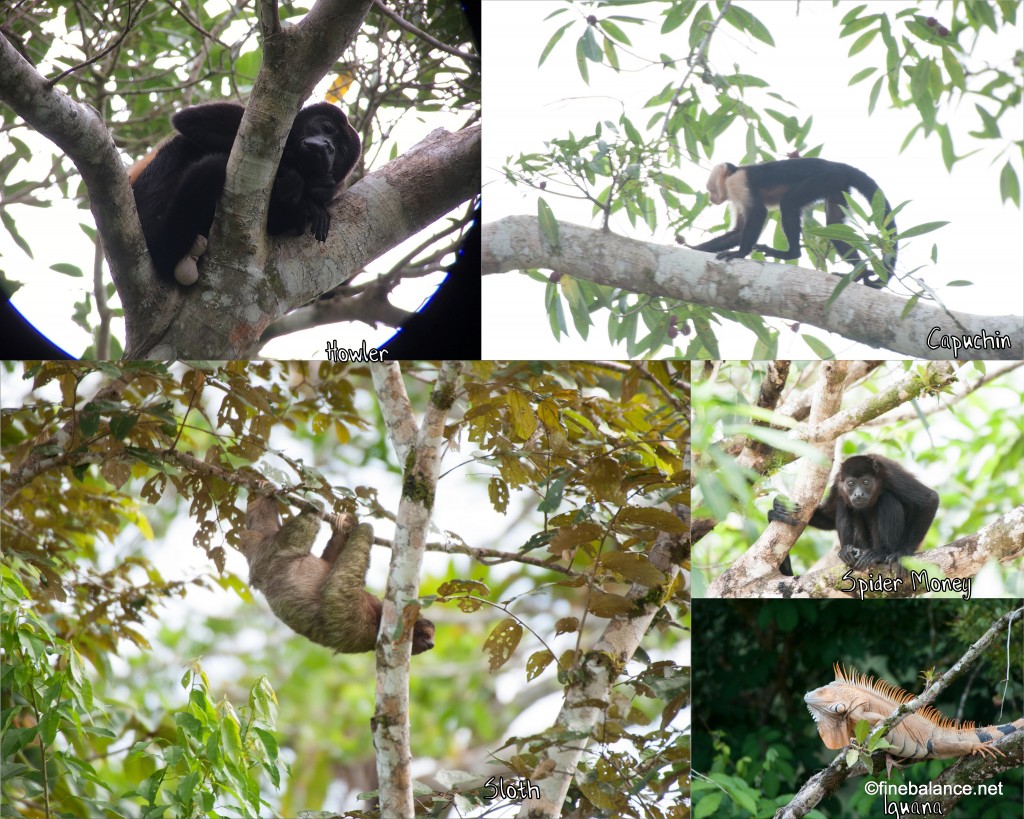
We saw the two-toed sloth. The good thing about sloths is that you can take your time to spot them because they are so slow moving. Sloths are nocturnal tree dwelling creatures so if they are hanging upside down on a tree during day time, they are easy to spot. We saw Howler monkeys, whose calls can travel several miles and iguanas and toucans. We then went back to the local family for lunch where they had laid out a feast for us. More casados, one special vegetarian for my mom and an in-house smoked pork one for me. They also had an amazing dessert called buneulos that reminded me of gulab jamun. They are small balls made by combining yucca and cheese and fried till they are golden brown and then covered in sugar syrup.
It was a very pleasant trip managed by Jacamar tours and I was very impressed with their service. I would have provided Jacamar five star reviews if it wasn’t for the evening tour that we did. When they didn’t turn up at the assigned time, the hotel called Jacamar tours and we realized that they had no record for us. They scrambled to find us a guide, who was probably a last minute replacement. Our guide took us to a private garden owned by Jacamar for a two hour walk guided by flashlights. We started off by seeing a rain frog and then another variety of rain frog. Then we walked and walked and pretty much saw nothing. Then I noticed a sleeping toucan and S noticed a couple of other birds sleeping. This is when we realized that the guide was clueless. If we could spot them and not him, then he probably was not a good spotter. After walking for about an hour seeing only two frogs, he started getting desperate and showing us another frog and yet another frog, all in the same pond. Fortunately, the tour ended before he decided to point out the mosquitoes. After a snack of arepas, we were dropped back to the hotel.
Mistico Hanging Bridges and Rainforest Canopy
The next morning, we went to see the hanging bridges at Mistico Arenal Hanging Bridges Park, just outside the Arenal Lodge. They are a series of about 14 suspension bridges each one at a different height and length. They are not only an engineering marvel but allowed us an up close and personal glimpse of the rainforest canopy. At some places we were so high that we couldn’t really see the forest floor. We decided to leave my mom with the kids and go on our own because my son was a bit nervous about these pathways and insisted on us carrying him.
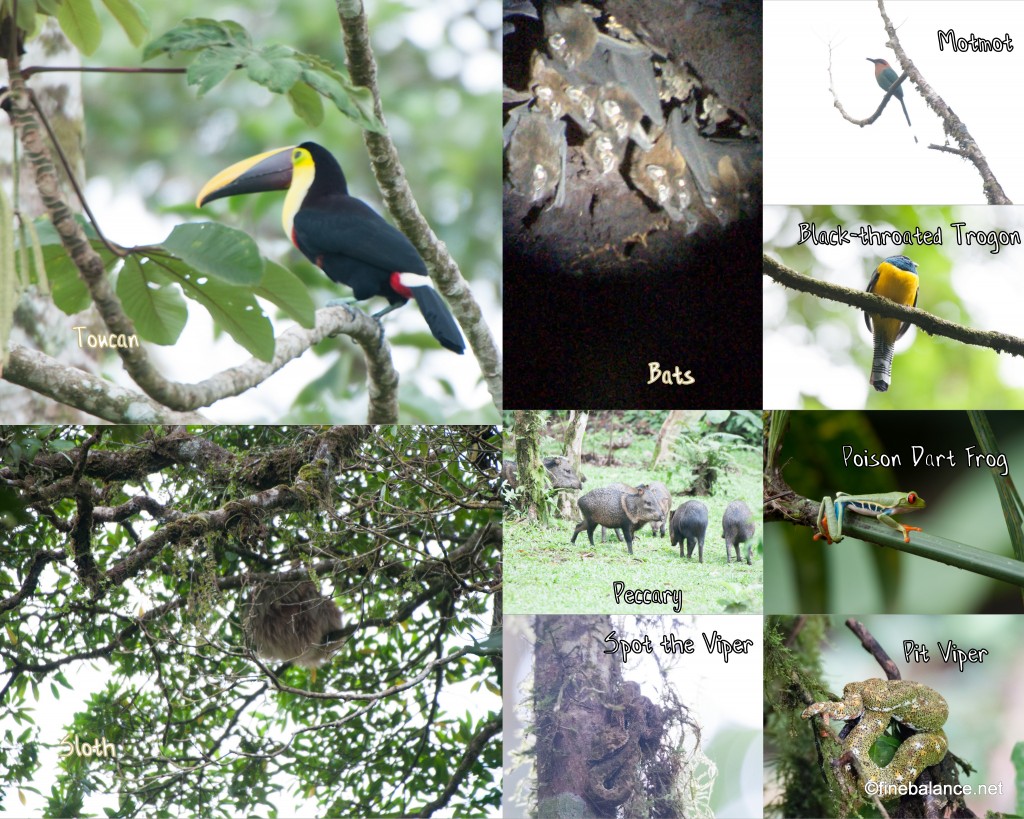
The animal spotting gods smiled at us and we saw toucans and poison dart frogs at the start. A whole family of peccaries came out of the forest, waited for a few minutes and then disappeared inside again. We saw a family of bats, the aptly named penis root tree, a well camouflaged pit viper, three toed sloths and a variety of birds. We heard the screams of the howler monkeys and then we saw them a little while later. The scariest experience was my almost encounter with a pit viper. My shoe was loose so, I casually supported myself on a nearby tree with one hand as I fixed my shoe. Moments later, our guide pointed out a pit viper on a tree a few steps away, in the spot that I had held on to. It was so well camouflaged that I wouldn’t have had a clue, and may have disturbed it. That did send a shiver down my spine.
After lunch, we visited Baldi Hot Springs Resort, where geothermal waters heated by volcanic activity flow naturally into terraced pools. The mineral-rich waters are believed to promote muscle relaxation and circulation. We were not impressed by the kids area because the water was too cold, but the hot pools were amazing. We started at the warmer end and slowly made our way to the other side where water flows into the pools where we received a pounding massage. We lazed in the water, had a couple of drinks and then cleaned up and stopped for dinner.
The security guard at Arenal Lodge had insisted that we stop at Nene’s restaurant to have the best ever ceviches. Not having a better alternative, we did exactly that. The ceviches were indeed wonderful. In fact the ceviches we had everywhere on this trip were fresh and never disappointing. We had a leisurely breakfast the next morning at the Arenal Lodge. Breakfast usually had rice, beans, fried bananas, sausage links, eggs, pancakes, fresh fruits and assorted breads. While the food was good, the excitement was watching birds attack the fruits they kept on a ledge. We could always see an assortment of tanagers eating the fruit. After breakfast, we stopped at the Arenal area to pick up some wooden souvenirs and then drove back to San Jose.
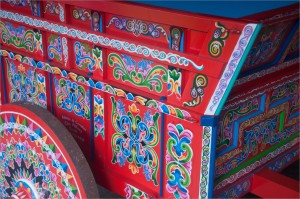
On our drive back toward San José, we stopped in Sarchí, famous for its hand-painted oxcarts. Historically used to transport coffee from plantations to ports, these brightly decorated carts are now a national symbol and recognized by UNESCO as intangible cultural heritage. Sarchi houses a small factory that still makes these oxcarts by hand and paints them, but they are now sold as souvenirs and collectibles.
Final Reflections
Costa Rica covers only about 0.03 percent of the Earth’s landmass but contains roughly 5 percent of the world’s biodiversity. Its commitment to conservation, renewable energy, and education distinguishes it within Central America. Many people from United States have relocated to Costa Rica creating a thriving expat community. From scarlet macaws in Carara to sloths in Caño Negro, from mist-covered bridges in Monteverde to volcanic vistas in Arenal, Costa Rica delivers both ecological richness and cultural depth. And in the end, its philosophy of Pura Vida is not a marketing slogan. It is visible in the national parks, the investment in education, the pride in local food, and the sense that protecting natural beauty is a collective responsibility.