



Two Days in Delhi: A Monument-Packed Itinerary That Actually Works:
Delhi! India’s capital city, a place where centuries of history jostle for space with modern India, and where almost every street corner seems to have a monument, a market, or a story to tell. I had visited twice before, but this was a first for my family. I filled our two days with some of my favorite monuments, and a few new to me monuments that were on my “must-visit” list. If you have two days in Delhi, I genuinely think this is a solid itinerary to follow, though I’ll admit upfront that we did not see everything, and we made a few compromises along the way. There was, however, one formidable obstacle: Delhi in August. We visited in the middle of the monsoon season, which meant a delightful combination of heat, humidity, and intermittent rain. This was the kind of energy sapping heat that makes stepping outside feel like an ordeal and made every air-conditioned car, restaurant, and hotel lobby seem like an oasis. The silver lining was that the monsoon rains appeared to have washed away much of Delhi’s infamous smog. We had surprisingly clear skies and didn’t experience the pollution that so often makes headlines about the city.
Day One: Raj Ghat, Red Fort, Lotus Temple, Dilli Haat, and Qutub Minar
Raj Ghat and the Memorial Complex

We started at the Raj Ghat complex, home to memorials for several of India’s political leaders. This single area is rich with history: Raj Ghat itself, with its eternal flame, marks the cremation site of Mahatma Gandhi. Nearby are Veer Bhoomi for Rajiv Gandhi, Shanti Van for Nehru, Shakti Sthal for Indira Gandhi, Vijay Ghat for Lal Bahadur Shastri, and Kisan Ghat for Charan Singh, among others. We only stopped at Raj Ghat and the closest one, Veer Bhoomi, but even that was enough to turn into an impromptu history lesson for the kids. My kids, who had not necessarily signed up for an intensive Indian history course during their summer vacation, found themselves receiving one anyway.
Red Fort, From the Outside
Next was the Red Fort, though we only saw it from outside. It was closed for upcoming Independence Day celebrations, which, in hindsight, we probably should have anticipated given our August timing. Built by Mughal Emperor Shah Jahan (of Taj Mahal fame) in the 17th century, the Red Fort served as the principal residence of the Mughal emperors after the capital moved from Agra to Delhi. Today, it is also the site from which India’s prime minister traditionally addresses the nation on Independence Day.
Lotus Temple
From there we headed to the Lotus Temple, the striking white, flower-shaped Bahá’í House of Worship that has become something of a Delhi icon. It’s a quick but worthwhile stop, especially if you want a change of architectural pace from the sandstone monuments dominating the rest of the itinerary.
Lunch at Dilli Haat

Dilli Haat was a first-time visit for me, and I confess that I came away a little disappointed. While the concept of an open air market showcasing artifacts & food from different parts of India is appealing, it really was just a tourist attraction. If you’re after artifacts and shopping, I would actually recommend the state emporium complex instead. Those are state sponsored, so there’s more of a guarantee of authenticity, prices are fixed so you’re not haggling or getting ripped off, and the crowds are far thinner. If you are there purely for the food, it’s not bad. For my NRI eyes, hygiene was still questionable in most of the stalls, but once we got past that initial hesitation, we landed at the Nagaland stall and had momos and a pork belly rack. Genuinely delicious.
Qutub Minar

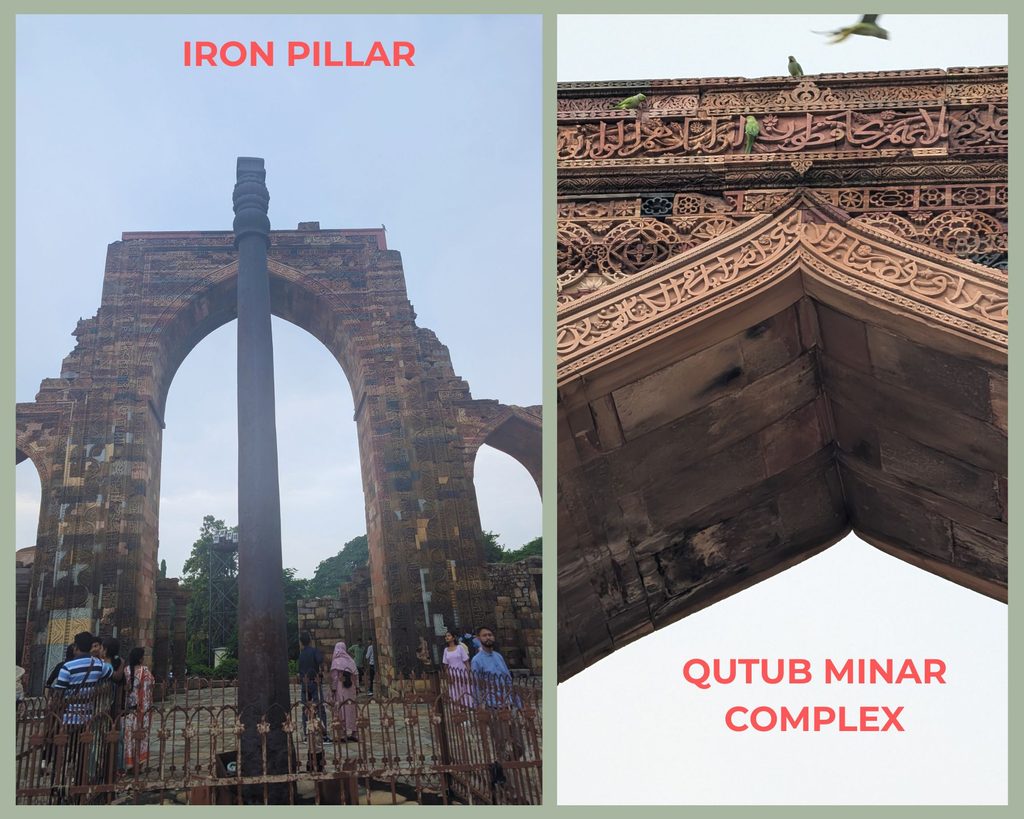
Our final major monument of the day was the Qutub Minar complex, a UNESCO World Heritage Site that dates back to the earliest years of the Delhi Sultanate. Construction of the tower began around 1199 under Qutb-ud-din Aibak, the first ruler of the Delhi Sultanate, with subsequent rulers continuing the work. The complex includes the Qutb Mosque, a major gateway called Alai Darwaza, and a tomb, all carved with calligraphic inscriptions from the Quran. The Qutub Minar is an extraordinary tapering tower, standing 72.5 meters tall, constructed primarily from red and buff sandstone, probably built as a minaret serving the adjacent mosque. It once had an interior staircase visitors could climb (famously shown in old Bollywood films, including Dev Anand’s Dil Ka Bhanwar Kare Pukar). Access inside is prohibited now. There’s an even older structure tucked into this complex that deserves equal attention: the Iron Pillar, originally erected by Chandragupta II Vikramaditya between 375 and 414 AD. It’s made of iron and has survived centuries without rusting, which has puzzled metallurgists and historians for ages. How did ancient engineers create an alloy that resists corrosion for over 1,600 years? Modern scientists attribute it to a particular composition of iron and a protective layer but its still not clear how they managed to do that 1500 years ago without modern technology. And this is what I love about Delhi. Within the boundaries of a single monument complex, you can encounter structures separated by nearly a thousand years of history.
Dinner at Bukhara
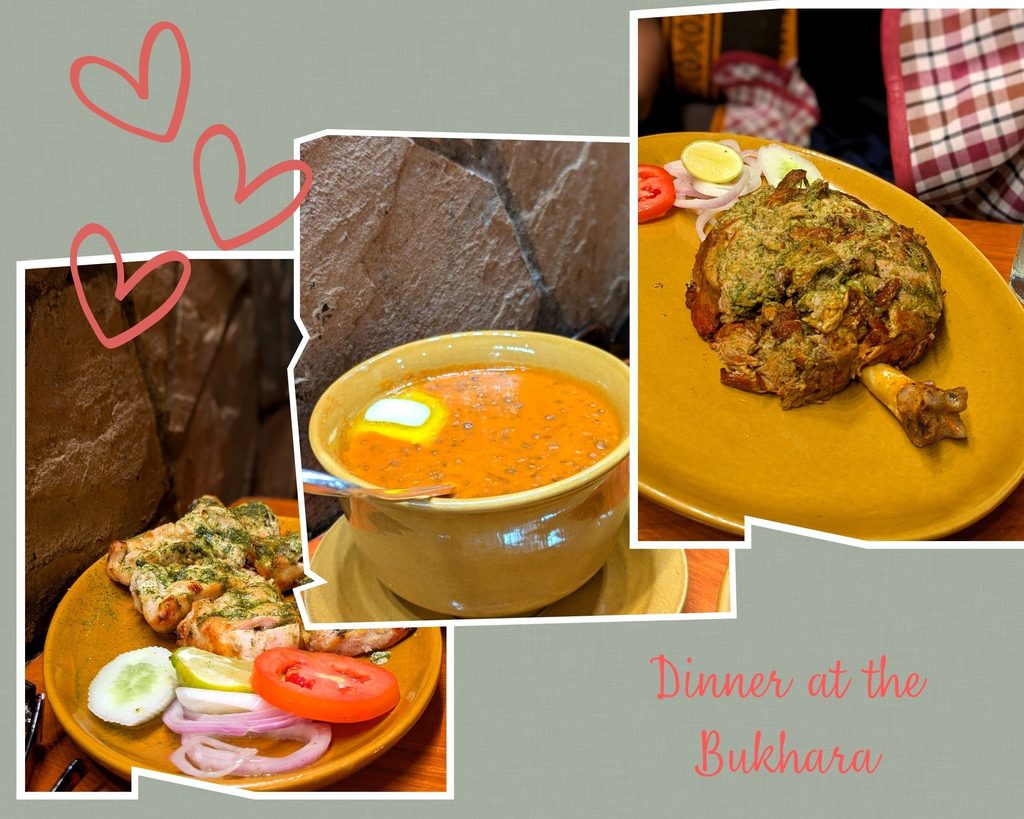
We ended the day with dinner at Bukhara, the famous Delhi institution known for its Dal Bukhara and classic Punjabi cuisine. It was a thoroughly enjoyable meal and a welcome opportunity to sit in air-conditioned comfort after a day spent exploring monuments.
Day Two: Humayun’s Tomb, Sunder Nursery, Agrasen ki Baoli, India Gate, and Chandni Chowk
Humayun’s Tomb


On Day 2, we were joined by my sister and her family as well. When I was making my list of must-see places in Delhi, Humayun’s Tomb topped it, and it did not disappoint. This is, by far, my favorite structure in the city. It’s stunningly beautiful, and I understand why some people rank it even prettier than the Taj Mahal. Built in the 16th century, Humayun’s Tomb is one of the earliest and grandest examples of Mughal architecture in India. Its enormous white marble dome, striking red sandstone façade, graceful arches, and perfectly symmetrical gardens that established Mughal architecture and style that eventually culminated in the Taj Mahal. Humayun was the great-grandfather of Shah Jahan, who was inspired by the symmetrical quadrilateral layout when designing the Taj Mahal. There is also a lovely reversal in the stories behind these two monuments. While Shah Jahan built the Taj Mahal for his beloved wife Mumtaz Mahal, Humayun’s Tomb was commissioned by his wife, Bega Begum, in memory of her husband. And while I admired the monument’s exquisite craftsmanship, I discovered something else to admire: its remarkably effective natural ventilation. You also have to admire the engineering behind it. Despite the blistering heat outside, the cross breeze inside the mausoleum created pockets of genuinely cool air, cool enough that I actually looked around for a hidden fan.
The complex is also a veritable city of tombs, earning it the rather amusing nickname “the Dormitory of the Mughals.” More than 150 members of the Mughal dynasty are buried here. One of the most interesting structures is Isa Khan Niyazi’s Tomb, which predates Humayun’s Tomb by about two decades. Built for a nobleman of the Sher Shah Suri dynasty, its octagonal design and architectural style are quite different from the grand Mughal mausoleum nearby. Though centuries old, it is easy to imagine how magnificent it must have looked when it was first built. One of the things I appreciate most about Delhi is that every monument provides an opportunity to explore a different period of Indian history. There are so many tombs in this complex that there’s even one called Nai-ka-Gumbad, supposedly (though unproven) the tomb of Humayun’s barber. If you have time to visit only one historic monument in Delhi, make it Humayun’s Tomb. It is, without question, my number-one recommendation.

Sunder Nursery
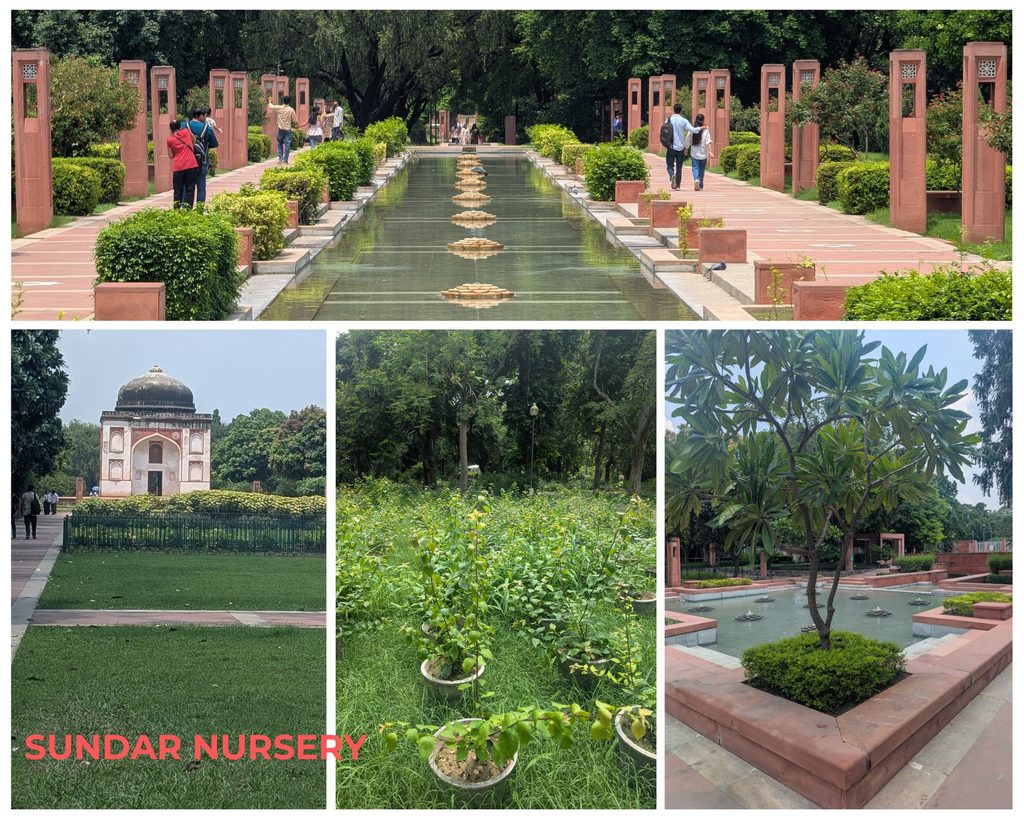
Right next to Humayun’s Tomb is Sunder Nursery, another spot that was new to me. It’s a wide expanse of green in the middle of the city, built in 2019, with a long rectangular water body running through the center, though it’s really a true arboretum. Step off the paved walkway and you’ll find pots and pots of seedlings being painstakingly grown for the rest of Delhi. We were beaten by the weather here too. The Delhi heat was unrelenting, and the area lacked shaded spots, so after a few obligatory photos, we admitted defeat and had to retreat. Still, we could see the potential the place has when the weather gods cooperate. Just perhaps not at midday in August. Sunder Nursery also includes six structures associated with the Humayun’s Tomb UNESCO complex, including Sunderwala Burj, which might be one of the least well known structures anywhere to carry UNESCO World Heritage status.
Agrasen ki Baoli
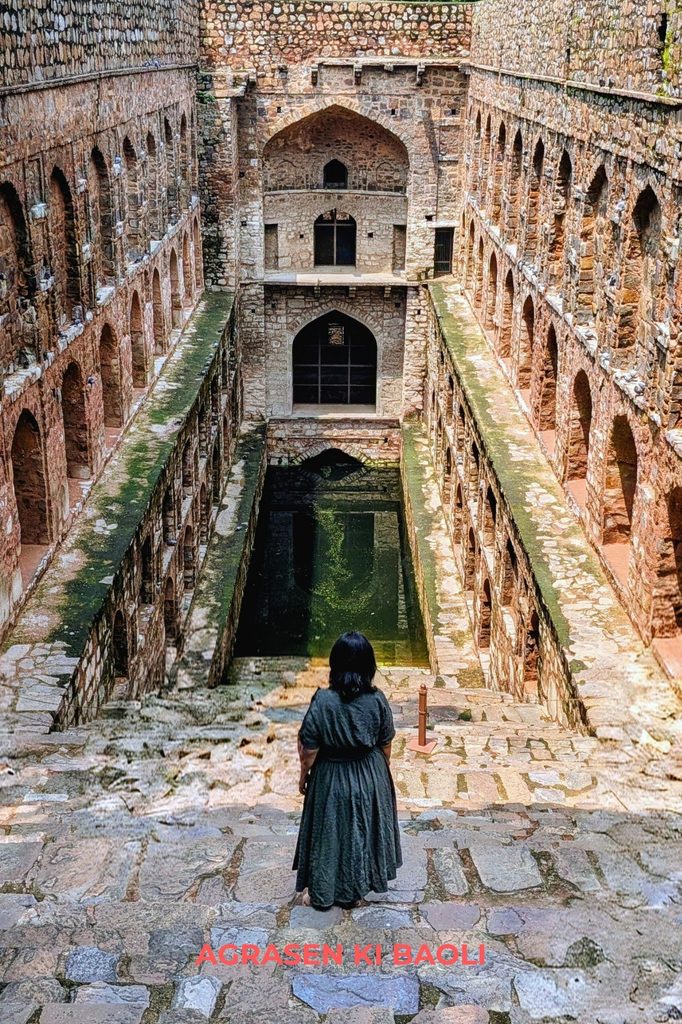
One of my new favorite spots in all of Delhi is Agrasen ki Baoli, a 14th century stepwell recently restored and opened to the public. It’s appeared in a few recent films, and it’s easy to see why. The concept of a stepwell is one of my favorite examples of India’s architectural ingenuity. These structures were designed to store and provide access to water, but their builders often transformed an entirely practical necessity into something extraordinary. Agrasen ki Baoli lacks the enormous scale and intricate ornamentation of the more spectacular stepwells in Gujarat and Rajasthan. But it has a quiet elegance of its own with 108 steps descending between tall stone walls lined with arched niches.
India Gate
We made a brief stop at India Gate, the towering war memorial that anchors one of Delhi’s most recognizable boulevards. Designed by Edwin Lutyens, India Gate bears some resemblance to the Arc de Triomphe in Paris. There is a direct path connecting India Gate and Rashtrapati Bhavan (Residence of the President of India) named Kartavya Path (Path of Duty). We would have preferred to stop by in the evening when it is lit up in the tricolor flag, but the itinerary did not allow it.

Lunch at Haldiram’s

Lunch was at Haldiram’s, which brings me to the subject of street food, something I debated endlessly on this trip. How does a self-confessed, chaat-obsessed foodie go to the capital of chaat and avoid the street stalls? This was a genuinely difficult call. I grew up on Mumbai’s street food. There was a time when my stomach lining was practically Teflon-coated. I could happily eat street food from roadside vendors without giving it a second thought. But after more than two decades of living outside India, I have come to the unfortunate conclusion that my gut microbes have become foreigners too. Discretion being the better part of valour, we ate our chaat at established shops like Haldiram’s or Bikanervala rather than from roadside stalls. Is that a culinary travesty? Undoubtedly. Purists will say I didn’t really “see” Delhi this way. Will street-food purists argue that I haven’t truly experienced Delhi? Almost certainly. But did all 8 of us survive the trip with our stomachs intact? Yes. And I am counting that as a win. It was tough but the lack of cleanliness around some sites, especially with the rain, made the decision easier too.
Jama Masjid and Chandni Chowk

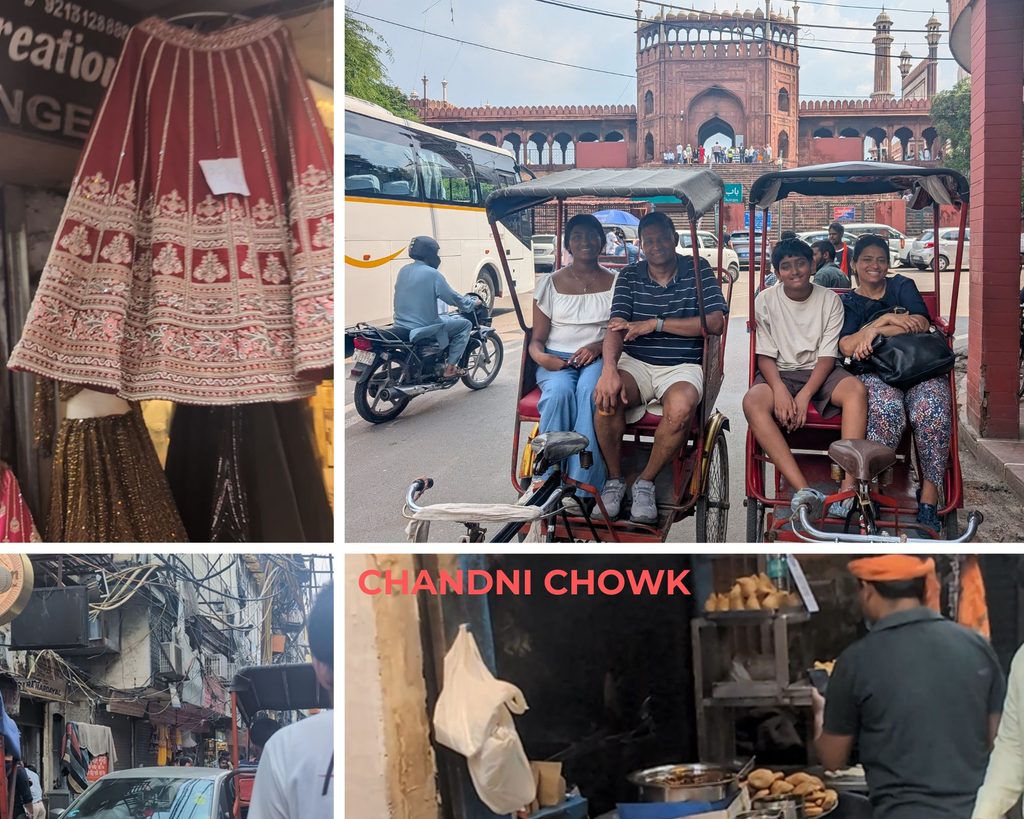
Our last big stop was Jama Masjid – again built by Shah Jahan. I am beginning to understand why Aurangzeb , his son, imprisoned this guy. Clearly, he had no concept of “following a budget”. In addition to the Taj Mahal, he built the massive Red Fort, its mirror image in Agra Fort, the Jama Masjid, a host of other structures and was on his way to build a companion for The Taj – the black Taj Mahal. I have huge sympathy for his son, how who had to imprison him to take away his checkbook. Our next stop was Chandni Chowk. Almost every Delhi travel vlog seems to follow the same formula. A wide-eyed foreign tourist lands at Delhi airport, heads straight to Chandni Chowk, and is promptly overwhelmed by the sights, sounds, smells, crowds, and general chaos of an Indian bazaar. Naturally, I wanted my own “foreign” kids to have the same experience. We hired a cycle rickshaw (a tanga) and rode through the narrow bylanes for about 15 to 30 minutes. This area has largely transformed into a budget wedding and bridal shopping district now. Shops selling kurtas, turbans, footwear, bangles, dazzling bridal lehengas, pooja items, and every imaginable piece of wedding paraphernalia line these tiny lanes on both sides. Overhead there’s a tangled mess of wires, bright lehengas hang from electricity poles at eye level, the smell of fried food is everywhere, and the narrow roads keep splitting off into even narrower bylanes. The famous Paranthe Wali Gali branches off from here, but given the hygiene factor, we skipped it. It was colorful, chaotic, crowded, fascinating, and utterly overwhelming. I loved it. But my husband wasn’t a huge fan.
Dinner with Cousins at Connaught Place.
We ended the trip with dinner at Connaught Place alongside my Delhi cousins, a relaxed, familiar way to close out two days that had otherwise been a sprint through centuries of history. My cousins made their way from Gurgaon and Noida and other parts of Delhi to centrally located Connaught Place, with its distinctive circular colonnades, shops, and restaurants.
Worth the Sweat
This is an ambitious itinerary, and it worked best for us because we had a car and driver and were comfortable moving quickly between attractions. If you enjoy a slower pace, I recommend spreading these sights over three days. Delhi can be exhausting and overwhelming but it is also a city where you can cover more than 1,500 years of history in two days, eat your way through several Indian states, and find yourself admiring an ancient monument while impatiently waiting for your air-conditioned car.